“With every museum visit I bought more postcards, and little by little my collection expanded until it ran into the thousands. I then began to put together exhibitions, in small boxes in my bedroom or on panels…”
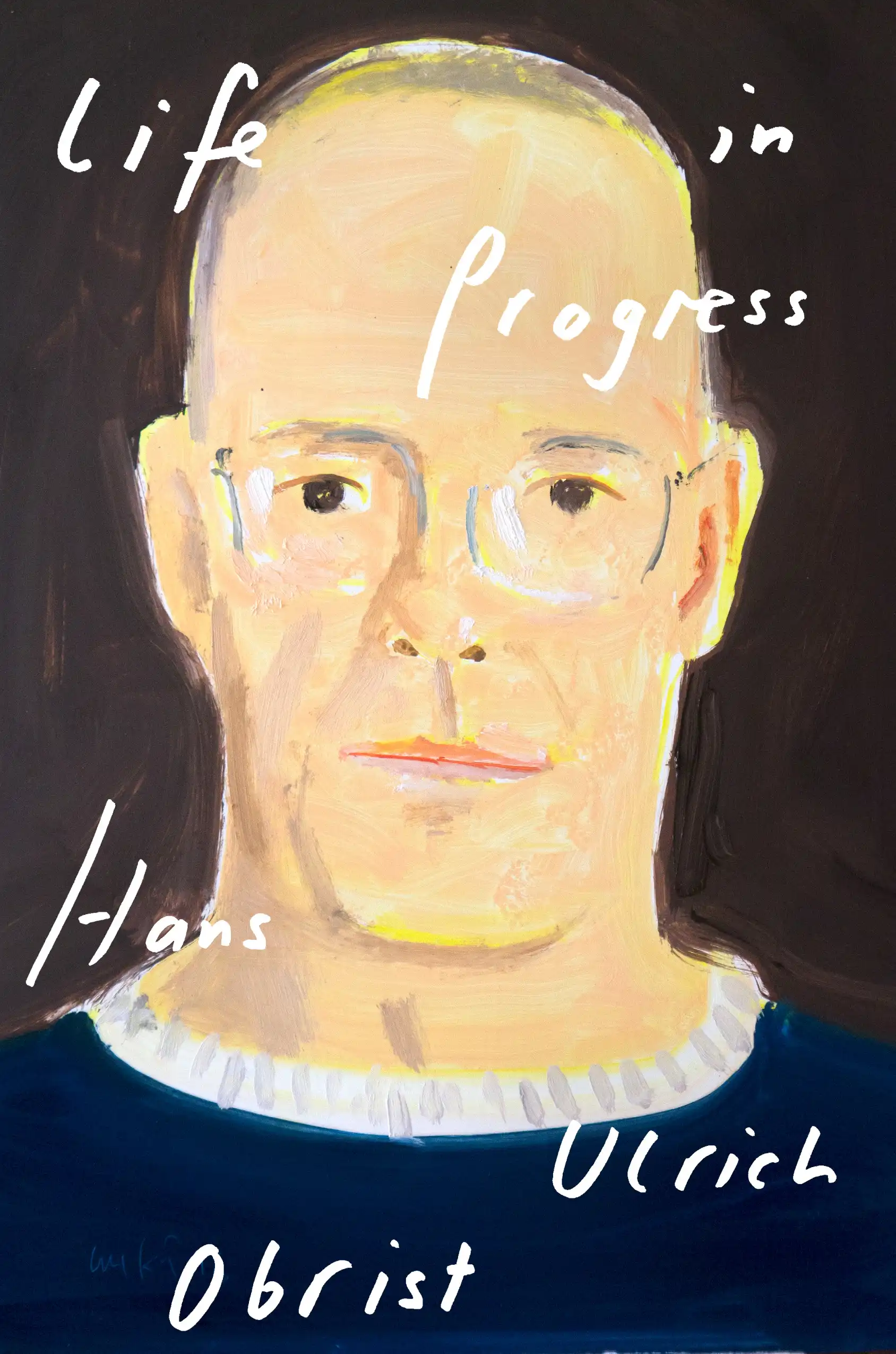
Hans Ulrich Obrist’s memoir Life in Progress is less a traditional autobiography and more a collection of reflections, conversations, and snapshots that capture his life as a curator and connector in the contemporary art world. Obrist is famous for his interviews, and the memoir reflects this. Much of the narrative is created from dialogues with artists, architects, and thinkers. He treats conversation as a creative act and a way to preserve ideas. A truly wonderful approach.
The journey that the reader is taken on is one of transit, with movement from continent to continent, city to city, idea to idea. The reader is pulled into his streams of experiences, from his early childhood days to the evolution of his major institutional work. His curatorial creativity is displayed in real time.
Although readers catch a glimpse of what is to come – when Obrist speaks of his ‘kitchen exhibition’ – one of the most important stories in Life in Progress is his very first exhibition, staged in a hotel room in St. Gallen, Switzerland when he was just 23 years old. Held in a small hotel room at the Hotel Carlton Palace, it featured multiple new generation artists installing works inside a temporary, intimate space. Although lacking institutional backing and a budget, it introduced Obrist’s curatorial skills to the art world and set the tone for everything he would do later in his career. It showed that art could happen anywhere. That artists were participants not just exhibitors. That form isn’t as important as testing ideas.
Rather than traditional life events found in most autobiographies, the key stops on this journey are people. Whether it is through his substitute grandmother (who had known Marc Chagall) or working with famed museum director Kasper König or meetings with influential figures like Gerhard Richter, Edouard Glissant, and Rem Koolhaas, Obrist’s world opens up to the readers through human connections. And this is what makes this memoir great. The reader is not told how this subject lives his life but rather experiences it.Hans Ulrich Obrist has served as Artistic Director of the Serpentine Galleries in London, where he leads one of the world’s most influential contemporary art programs. Earlier, he was Curator of Contemporary Art at the Musée d’Art Moderne de la Ville de Paris, shaping its international