“Cilantro illustrates how complicated it is to identify a flavor. Many people find this plant pleasant, but others despise it and say it tastes like soap or stink bugs.”
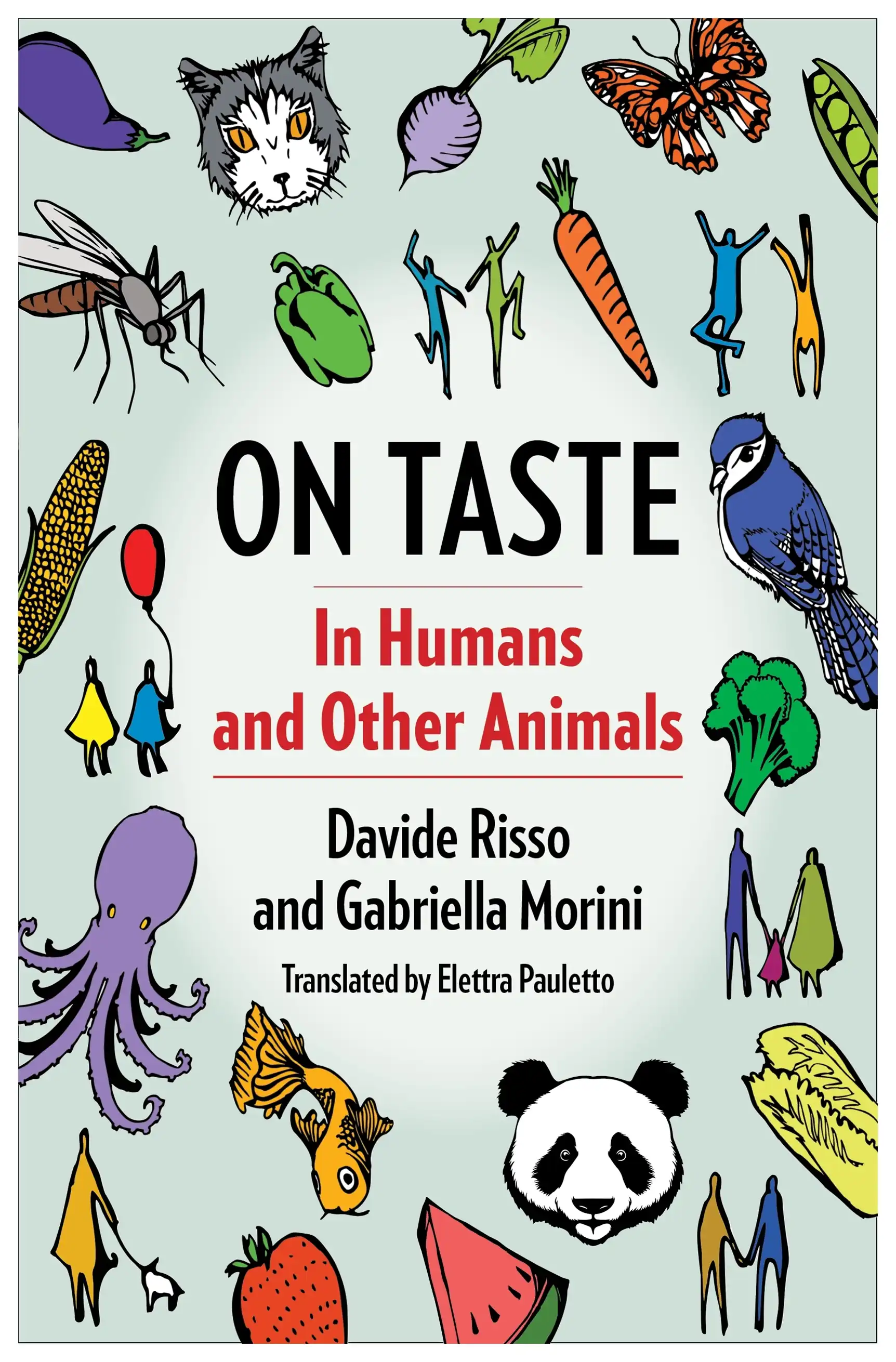
On Taste: In Humans and Other Animals is an exploration of one of the most fundamental of human senses. Blending biology, evolution, and cultural insight, the authors offer a fresh perspective on what it really means to “taste.”
At its core, the book challenges the familiar idea that taste is limited to five basic categories – sweet, salty, sour, bitter, and umami. Instead, Risso and Morini open a broader scientific conversation, asking whether sensations like the heat of chili peppers or the coolness of mint should count as taste at all. Or if calcium should be recognized as a taste as detecting it could help us regulate its intake. Whether the authors are plunging into how taste can trigger a warning system, how the interaction between receptor and ligand causes the mouth to close and trap compounds long enough to trigger mechanisms, or how taste receptors (especially bitter ones) are found in other areas of the body, there is example after example of interest to readers.
One of the book’s most interesting aspects is its evolutionary scope. Rather than treating taste as a purely human trait, the authors trace its development across millions of years, from microorganisms to complex animals. Readers encounter many memorable examples. Cats that cannot taste sweetness, pandas that have lost the ability to detect umami, and even mosquitoes that use taste cues to select their preferred human hosts. These details illustrate how taste functions as a survival tool, helping organisms distinguish between nutrients and toxins.
Importantly, although On Taste is a book based on science, the authors have written it in such a way that those not scientifically inclined can understand its content without oversimplification. The writing is clear and engaging – during the times it veers heavy, the writers explain the science behind it – and often infused with light humor, which keeps the tone from becoming overly technical. At just over a hundred pages, the book is concise, but it manages to cover a large swath of material.
On Taste bridges science and everyday experience, showing how something as routine as eating is shaped by evolutionary history, biology, and environment. By the end, taste emerges not just as a sensory function but as a lens through which we can better understand behavior, health, and even our relationship with other species.