It all began with the feel of leather.
“I was taken with the organic, earthy smell of leather, the warm earth tones, and the feel of it in hand,” says Cary Schwarz, a master saddlemaker and leatherworker. That feeling launched Schwarz into a rarefied career. One he has spent decades perfecting his art.
That dedication has landed Schwarz a bevy of honors and awards. Among others, he has earned recognition within the Western art and ranching communities, including the Idaho Governor’s Award for Excellence in the Traditional Arts. He has taken home Saddlemaker of the Year honors from the American Academy of Western Artists. And for 2026, the National Endowment for the Arts has named him a National Heritage Fellow, the nation’s highest honor in folk and traditional arts.
The accolades are indeed impressive, but Schwarz’s story is perhaps best understood through the way he talks about the work itself. It has never been simply about leather. It has been about the relationship between material and function, between horse and rider, between craftsmanship and art. It is about mentors and other craftspeople. Most importantly, by the thousands of hours he has spent at the bench in honing his craft. Continually focused on understanding why some things work and others do not.
A Saddle Begins with a Story
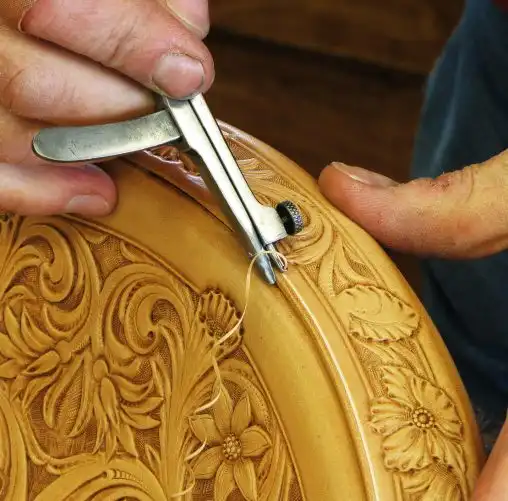
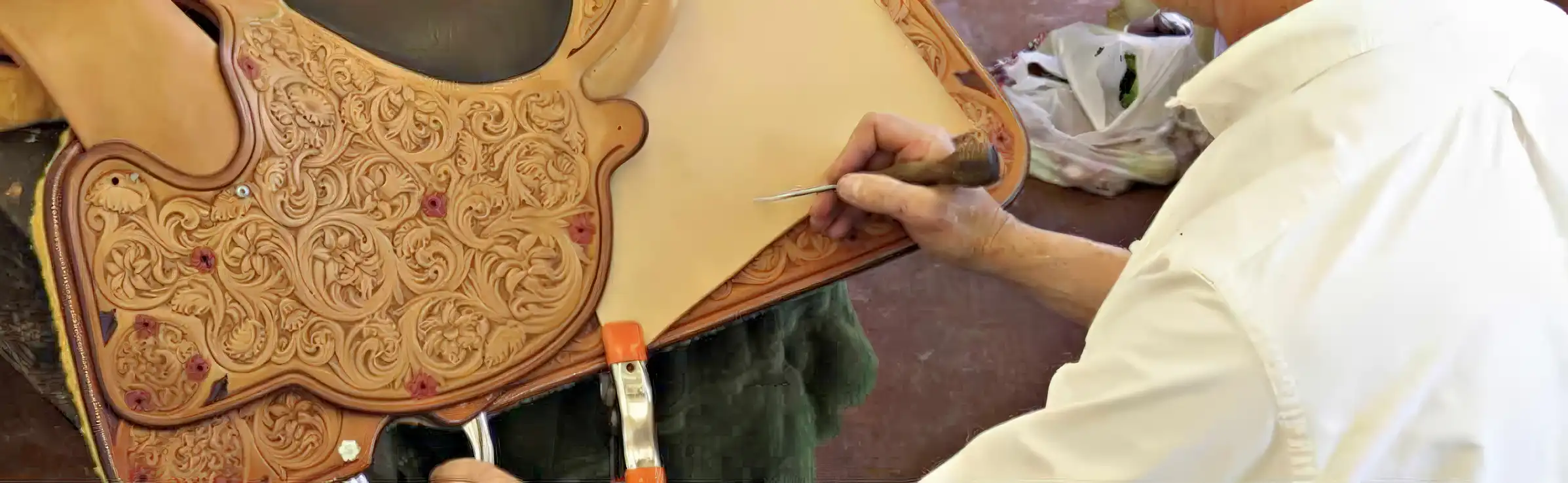
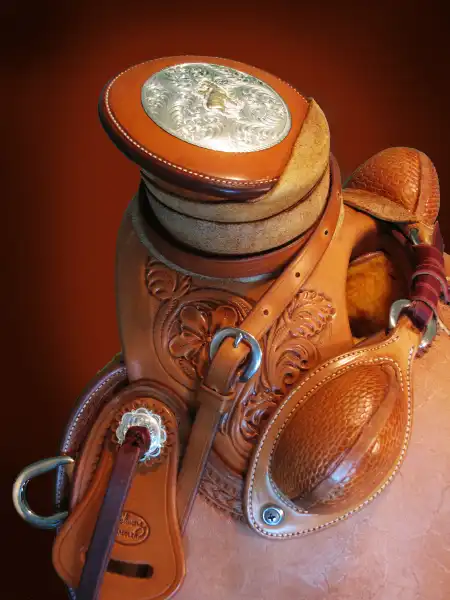
A handmade saddle is built from the inside out. It begins with the tree that provides the wooden foundation that determines the saddle’s shape and how it will fit the horse. From there, the maker carefully selects and cuts leather according to the characteristics of each section of the hide, shapes the seat and skirts, builds the rigging, and stitches the components together by hand.
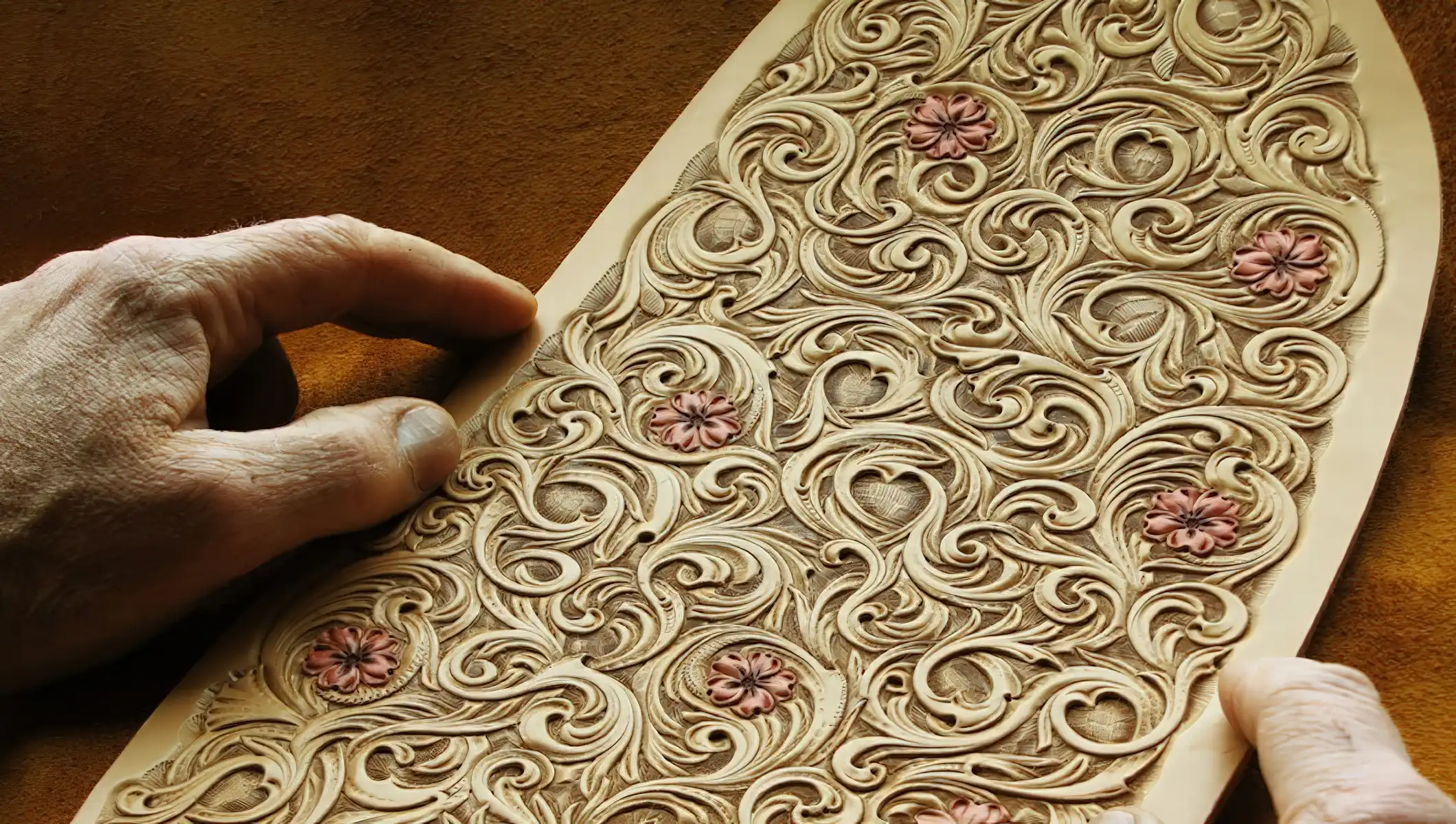
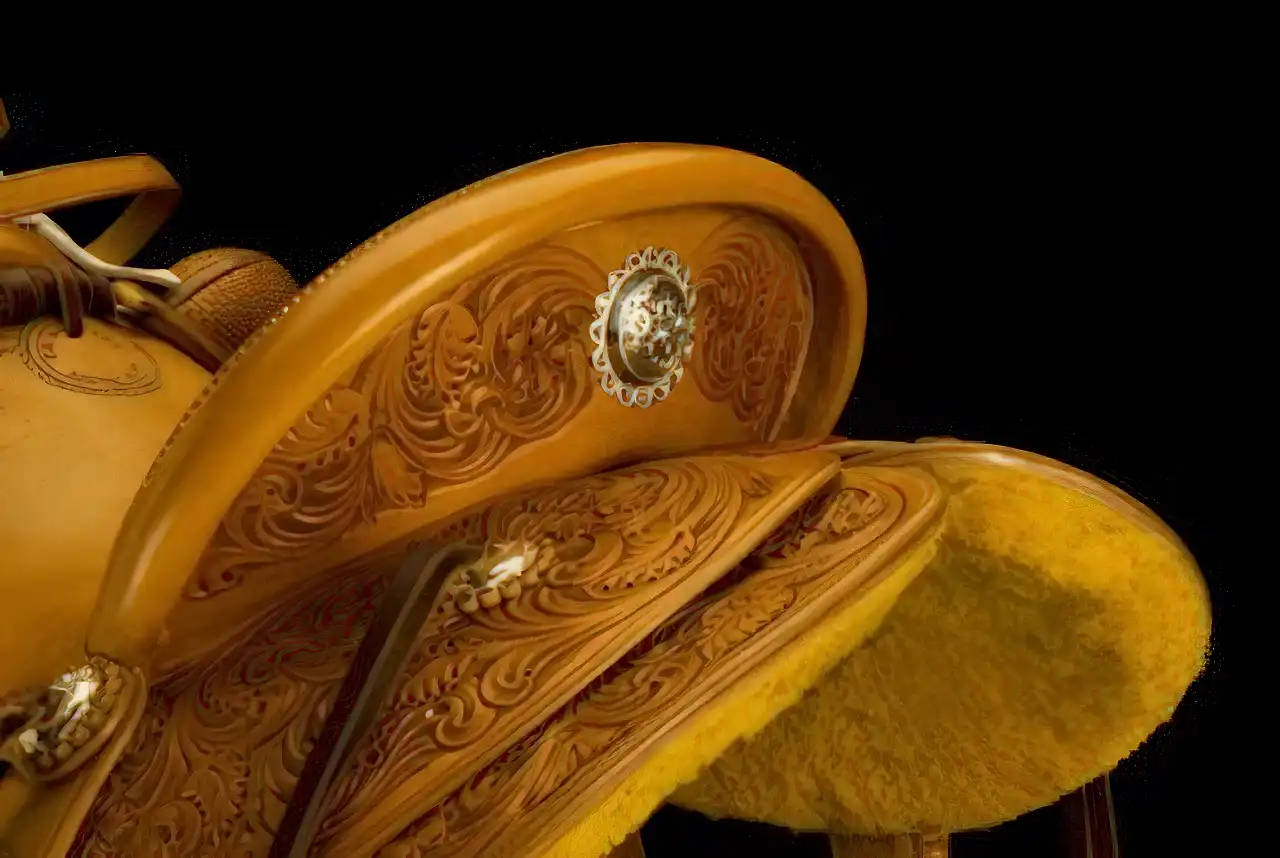
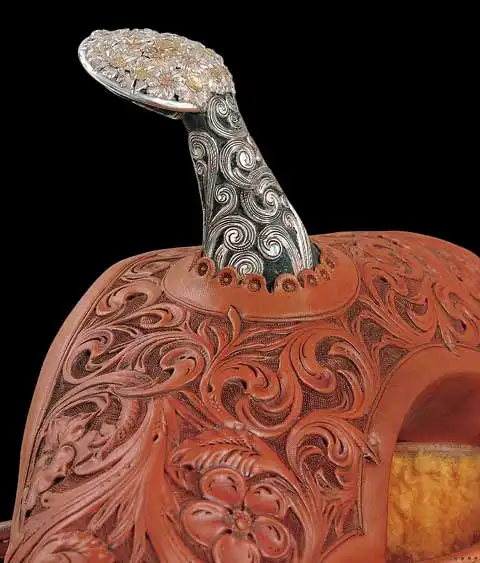
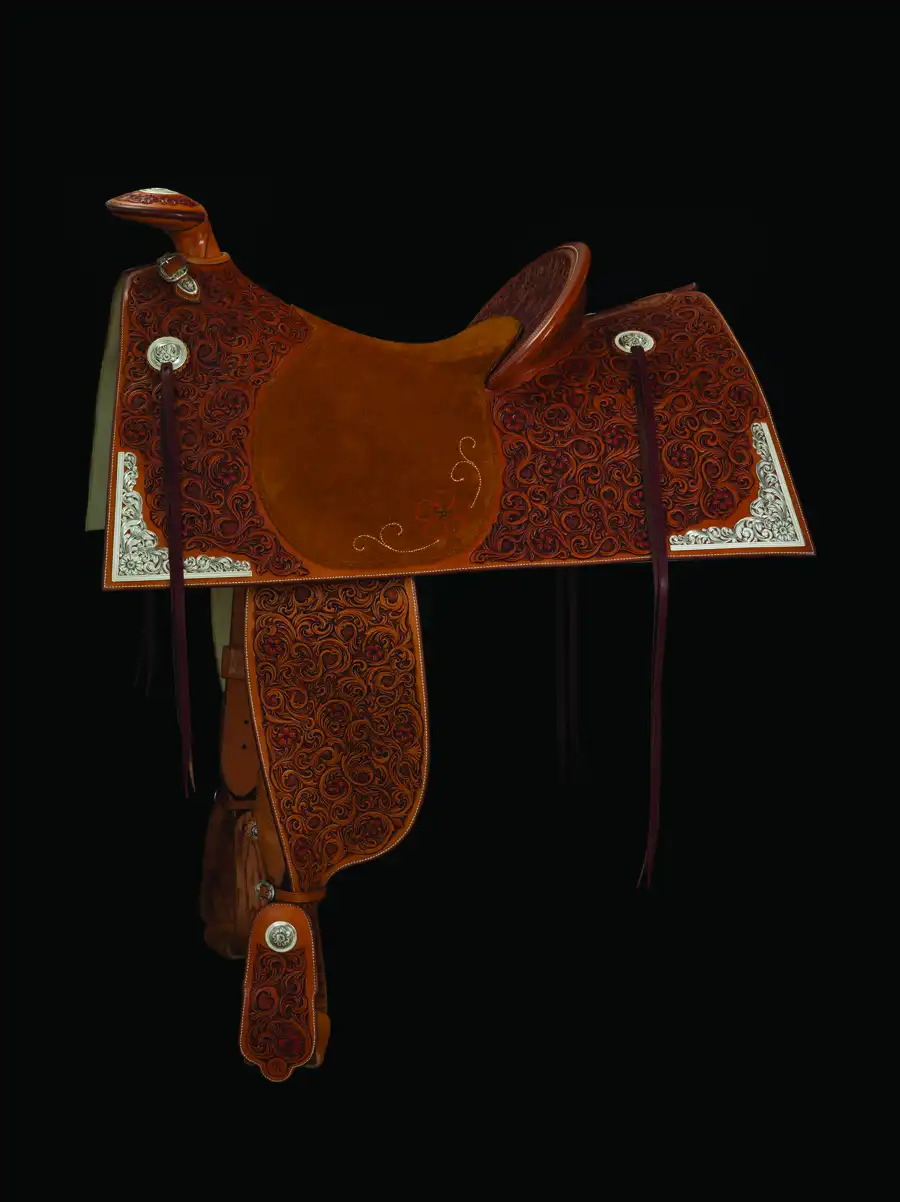
On a carved saddle, the decoration is designed and drawn before the leather is tooled, with every floral element fitted to the saddle’s architecture. Silver and stitching are added as the piece takes shape. The process can require weeks or months of concentrated work, depending on the complexity of the saddle.
Saddlemaking demands an unusual combination: one of physical skill, patience, knowledge of horses, an understanding of leather,and an artist’s eye for proportion. Every part must work together. The saddle must be strong enough for its job, comfortable for the horse and rider, and beautiful enough to reflect the hand of the person who made it.
Most of Schwarz’s saddles are commissioned. That means the process begins with a customer, a horse, and a conversation rather than with a pattern pulled from a drawer.
“A big part of the process is engaging with a client, listening to their story and trying to interpret it so that the saddle becomes a part of their narrative. I try to fit the functional needs of the customer and often work up some sketches to give them an idea of what I think they have in mind. Most of my clients trust my artistic intuition, so I am often ‘turned loose’ to create something unique and compelling. Designs are often built upon the scaffolding that I’ve been able to build out over many decades of artistic exploration. Occasionally, I come up with an idea that seems to appear out of thin air, though it is probably a result of studying floral motifs that have been used in ornamental architecture for centuries. My process of gesture drawing has opened my aperture of creativity that has enabled me to find new combinations of elements.”
Seeing in Three Dimensions
The designs may look spontaneous, but Schwarz describes them as the product of accumulated observation.
“I may see a compelling motif on something I’ve seen somewhere and then make a mental note of it. When the opportunity arises to give it a try, pencil and paper are the first order of business.”
For Schwarz, drawing is not separate from making. It’s part of the process of figuring out how an idea will occupy space, how one element will relate to another and, ultimately, whether the design can be translated into leather.
“Thankfully, I have been blessed with a gift of spatial reasoning…the ability to see things in my head, in 3D. This really helps when trying to get acquainted with a flower or leaf so that you can replicate it in leather. Over time, you develop familiarity with your tools and what they can do and come to see how some design elements can be executed successfully in leather. A three-dimensional design is always more interesting than a two-dimensional one.”
That ability to visualize the finished form becomes especially important when the decoration needs to follow the contours of a saddle rather than simply sit on a flat surface.
Learning From the Masters
Schwarz learned much of what he knows by studying other craftsmen. He points to Ray Holes, Dale Harwood, and Chuck Stormes as important influences, although each taught him something different.
“The Ray Holes Saddle Company started publishing a catalog in the 1930s. I studied the floral carving designs and saddle architecture, trying to emulate the organic style and flavor that I saw in those pages. Dale Harwood has helped me with the functionality of the saddles as well as his fine carving that was also inspired by the Ray Holes shop. Chuck Stormes has helped me with saddle construction, but most of all, I learned how to think like a mature craftsman.”
For Schwarz, that way of thinking is rooted in continual improvement rather than a moment of arrival.
“While trying to make the next saddle better than the last, it is almost always the small details that aggregate over time. The mentors I’ve had have shown me where those details are and ways to improve. The end result has been a certain maturity in my work that only comes through repetition and time.”
That same approach applies to the leather itself.
“Since leather is an organic medium, no two pieces are the same. After years of experience, you start to recognize textures and the feel of saddle leather…for example, whether it has a firm temper or is more limber. The art of leather selection comes down to matching the area of the hide to the appropriate part of the saddle.”
There are rules, but experience teaches a craftsman when those rules need to be reconsidered. That experience is accumulated through one hide, one saddle and one mistake at a time. It’s part of what distinguishes knowledge learned at the bench from knowledge learned from a book.
“There are generally areas of a side of leather that are automatically dedicated to certain parts of the saddle, but these guidelines can change depending on any number of variables. Careful study of the characteristics of leather will always keep you on your toes.”
The Horse Comes First
For Schwarz, the saddle can never be separated from the horse.He has written that “the context is always the back of the horse,” and that idea informs the architecture of his saddles as much as the decorative work.
“In the zeitgeist of saddles today, we see a lot of angular, straight lines that seem to have a lot of currency in the marketplace, but don’t fit the horse. I defer to the lines of a horse and seek to harmonize the architecture of the saddle to the lines that we see on a horse.”
It’s a philosophy that puts the horse ahead of fashion. Schwarz may be working within a tradition, but he is not interested in reproducing a look simply because it has become familiar.
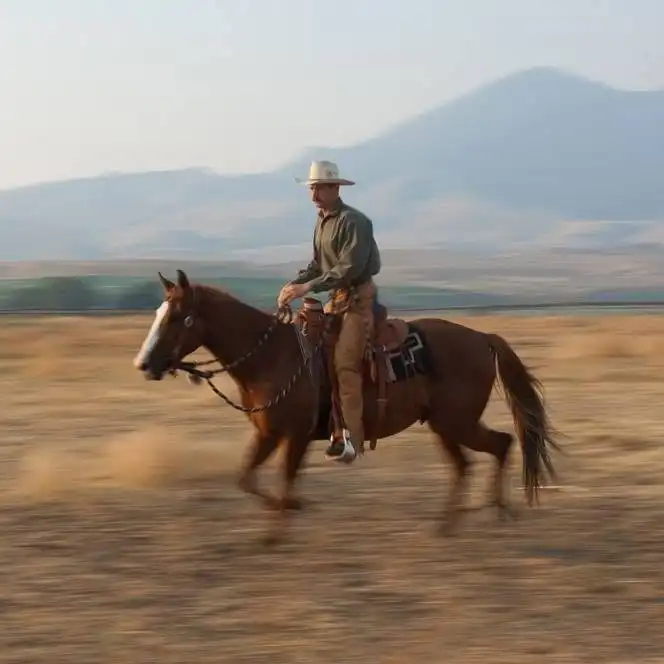
“The graceful curvatures and beautiful flow of a horse, whether standing or moving, tell us what is compatible for the lines of a saddle.”
That attention to structure extends to the parts of the saddle that most people never see.
“Functionally, I would say that having a good tree to start with, a good shape to the seat, and a solid rigging (that is what holds the saddle on the horse) are the things ‘under the hood’ that are mostly hidden yet, if you don’t have those three things, you don’t have a usable saddle.”
Schwarz has used New Zealand craftsman Warren Wright trees since 1992.
“There are many things about a tree that can make it or break it, pun intended. The shape and angles of the tree bars (which bear on the horse’s back) are critical to the function of the saddle. Warren is from New Zealand but uses West Coast American Douglas Fir for his trees. He uses dimensional lumber that issalvaged timber from buildings and warehouses. It is old-growth wood that is strong, yet light enough to not add unnecessary weight to the tree.”
Where Function Becomes Art
Schwarz has spent much of his career resisting the idea that a saddle must be categorized as either equipment or art.
“Most of the time, we can see that the craftsman has tilted toward the ‘art of the saddle’ by how much decoration has been applied. We tend to want to compartmentalize saddles as either being a tool or a work of art. In my career, I’ve tried to make the case that this is not necessary. Hence, ‘the best saddles made are a successful blend of function and art.’”
He prefers what he calls a “both/and” approach.
“Our culture would have us decide whether it is one or the other. I prefer to not make that distinction, viewing it as a both/and rather than an either/or forced decision. We might call it more of a holistic view of life.”
That balance changes depending on who will use the saddle. The difference is not a matter of one saddle receiving more care than another. Schwarz sees the same standard of craftsmanship applying to both. What changes is how much room the project gives him to pursue the artistic possibilities.
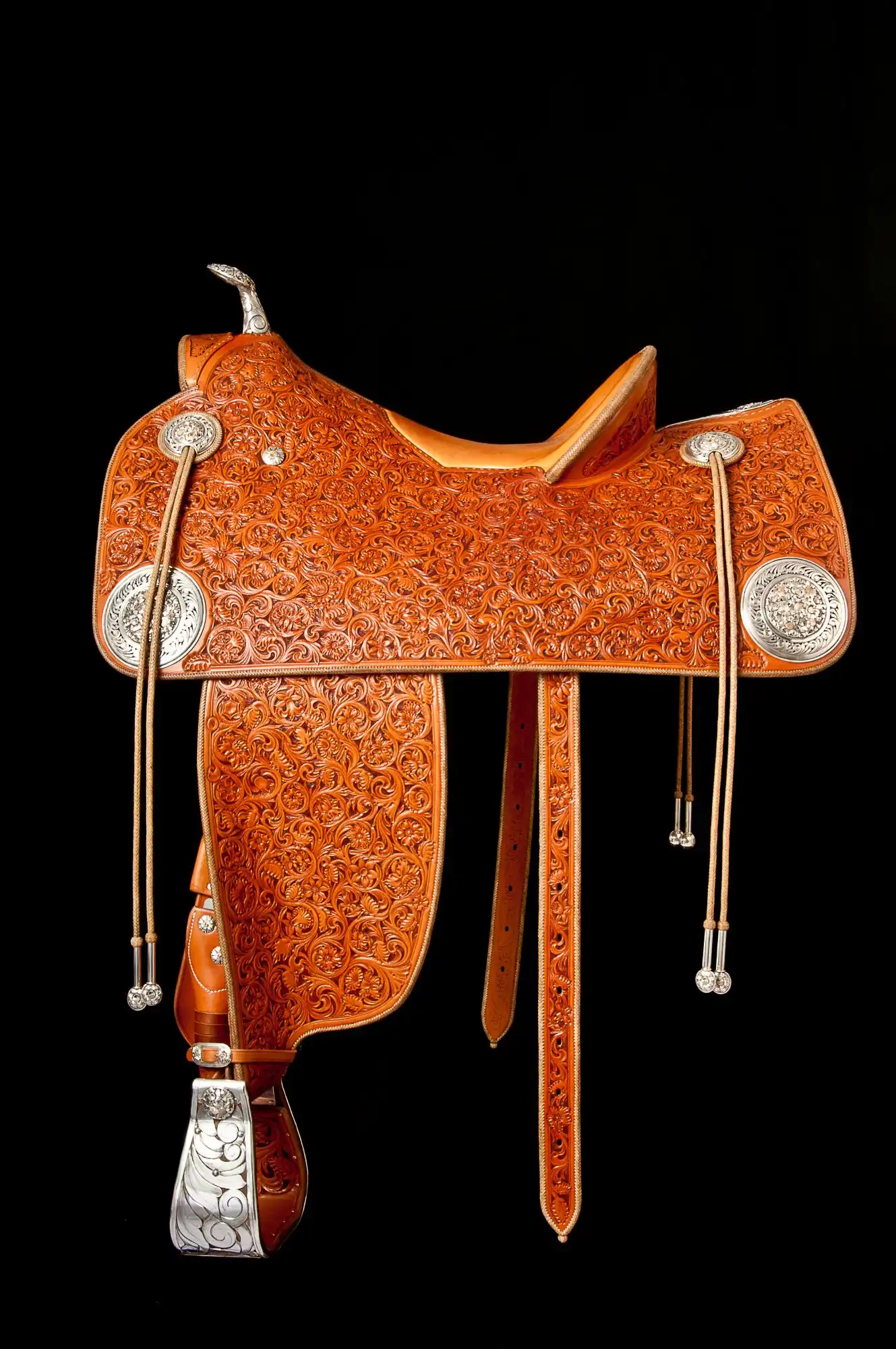
“When building a saddle for a rider who intends to use the saddle frequently, the balance point is placed where the integrity of the functional aspects is foremost. Then we incorporate artistic excellence where they make sense within budget constraints. That balance point shifts toward the artistic side of the scale with a collector type piece.”
Making collector saddles gives him greater freedom, but Schwarz doesn’t see that as a fundamentally different kind of work.
“I look at a ‘collector saddle project’ as an opportunity to explore what can be done artistically and allow creative impulses to direct the work. Having my work in the TCAA (Traditional Cowboy Arts Association) show every year since 1999 has allowed me that opportunity. I will say that even the cowboy saddles that I’ve made over the years have given me that opportunity as well. It is simply done within a smaller budget, which incidentally makes those projects more challenging, only in different ways.”
Is there ever a saddle that is too beautiful to ride?
“No. We hear this all the time… ‘that saddle is too pretty to use.’This statement simply shows the value system of the person saying this. What should be said is, ‘I wouldn’t use a saddle that is that beautiful.’ This subjective value system will vary widely across the landscape of humanity.”
Honorable Battle Scars
A working saddle changes with time. Schwarz can look at one and see evidence of what it has been through.
“Those areas of a saddle where the rider has contact will show wear. A cowboy’s saddle will often have a horn wrap that shows a ‘scald’ where a rope has burned grooves in the neck of the horn. Sometimes there is wear across the cantle where the rope has run across it when dragging calves to the fire at a branding.Occasionally we see spur tracks where a cowboy has been bucked off in such a way that his spurs lay down a dotted line across the seat during a violent exit. These are all what we call ‘honorable battle scars.’”
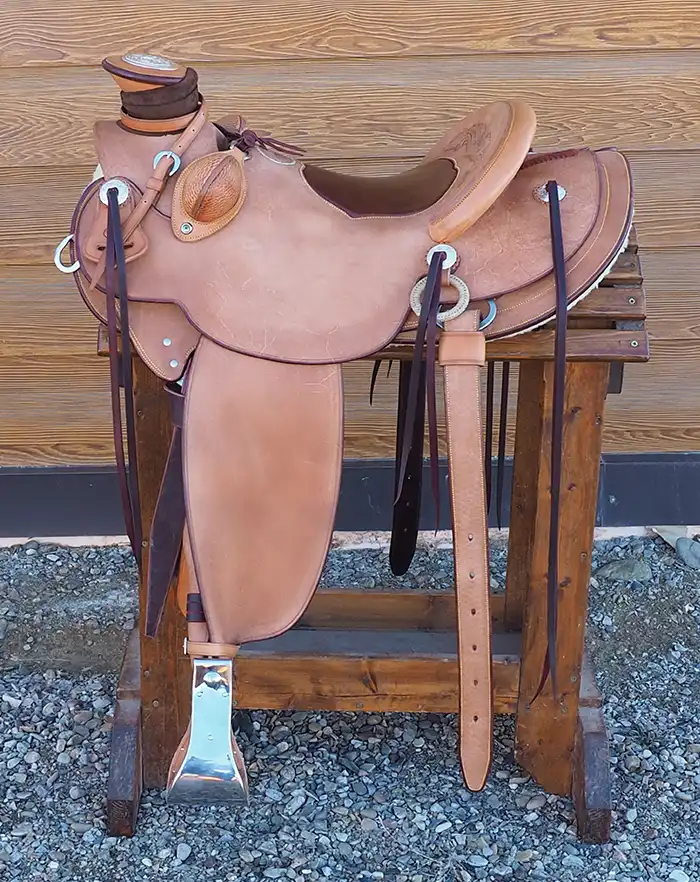
And those scars do not diminish the saddle.
“There is a certain beauty of a brand-new saddle ready for use, and another kind of beauty when it has been used.”
That distinction between the pristine and the lived-in is also part of what working cowboys understand that a collector may not. A collector can appreciate how a saddle looks. A working rider develops an understanding of how it feels. For Schwarz, that difference matters.
“The only way to truly understand how a saddle works under heavy use is to use it. Saddle trees may have small variations in angles and widths from one to the next, and it is impossible to know the difference until you ride it enough to get a feel for it. Innumerable variables relate to how the saddle is used and cannot be understood without many miles of experience that inform the rider as to its usability.”
Keeping the Craft Alive
For Schwarz, his craft has never existed in isolation. He was instrumental in founding the TCAA, which has become one of the central organizations for contemporary Western craftsmanship. The association brings together master artisans working in four traditional disciplines: Saddlemaking, bit and spur making, silversmithing, and rawhide braiding. Its stated mission is not simply to preserve old objects but to preserve the living craftsmanship and cultural heritage of the North American West.
That distinction matters to Schwarz.
The TCAA’s members are working artists, not historical reenactors. They continue to make objects intended to function, while pushing the design and technical boundaries of their disciplines. The association’s annual exhibition at the National Cowboy & Western Heritage Museum in Oklahoma City has become a major showcase for that work. In 2026, the exhibition runs September 12 through October 18.
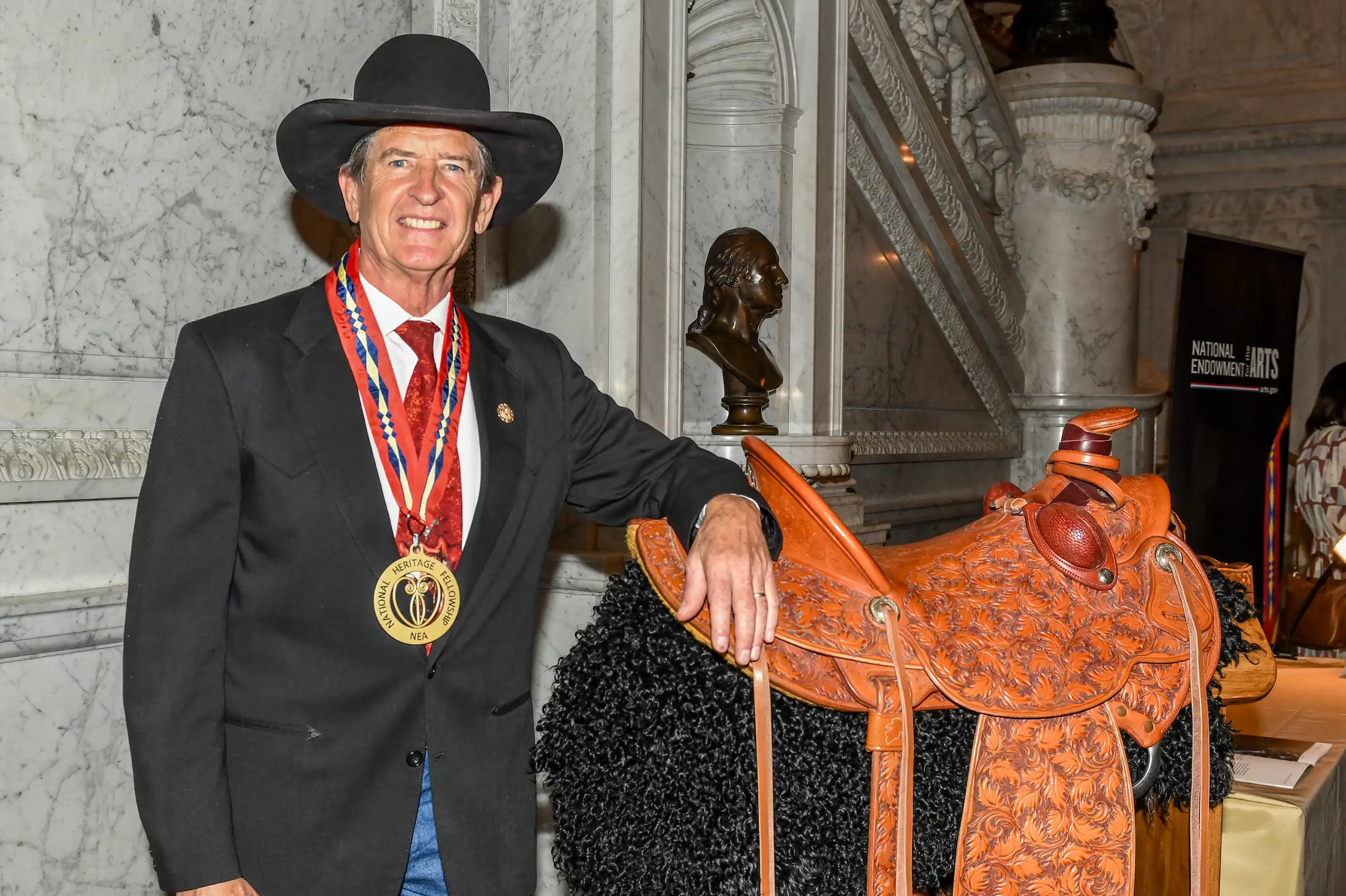
Schwarz is now an emeritus member, but he remains closely identified with the organization’s history. The TCAA currently has 14 living emeritus members, and the organization describes its artists as among the finest craftsmen working in their disciplines.
For Schwarz, one of the most important things the TCAA has created is an environment in which craftsmen can learn from one another.
“Most saddlers do not build their own trees, silver appointments, and stirrups, so it is essential to have a solid working relationship with those craftsmen who do that for a living. The silversmiths that I have collaborated with are top-notch artists. We work together to build out a project that complements each of our disciplines, not unlike a symphony where everyone does their part for the work that brings enjoyment and enriches the lives of our clients.”
His collaboration with silversmith Scott Hardy has continued for decades.
“In all true collaborations, there exists a symbiosis that occurs with the goal being a harmonizing of the different elements so that the whole is better than the sum of its parts. We discuss the overarching theme of the work and share ideas and techniques that feed into one another’s creativity, trusting the other to do the work that they are uniquely qualified for.”
The TCAA has also made mentorship a central part of its mission. For an organization devoted to traditional craft, that may be its most important work. A technique cannot be preserved simply by documenting the finished object. Someone needs to learn how to make it.
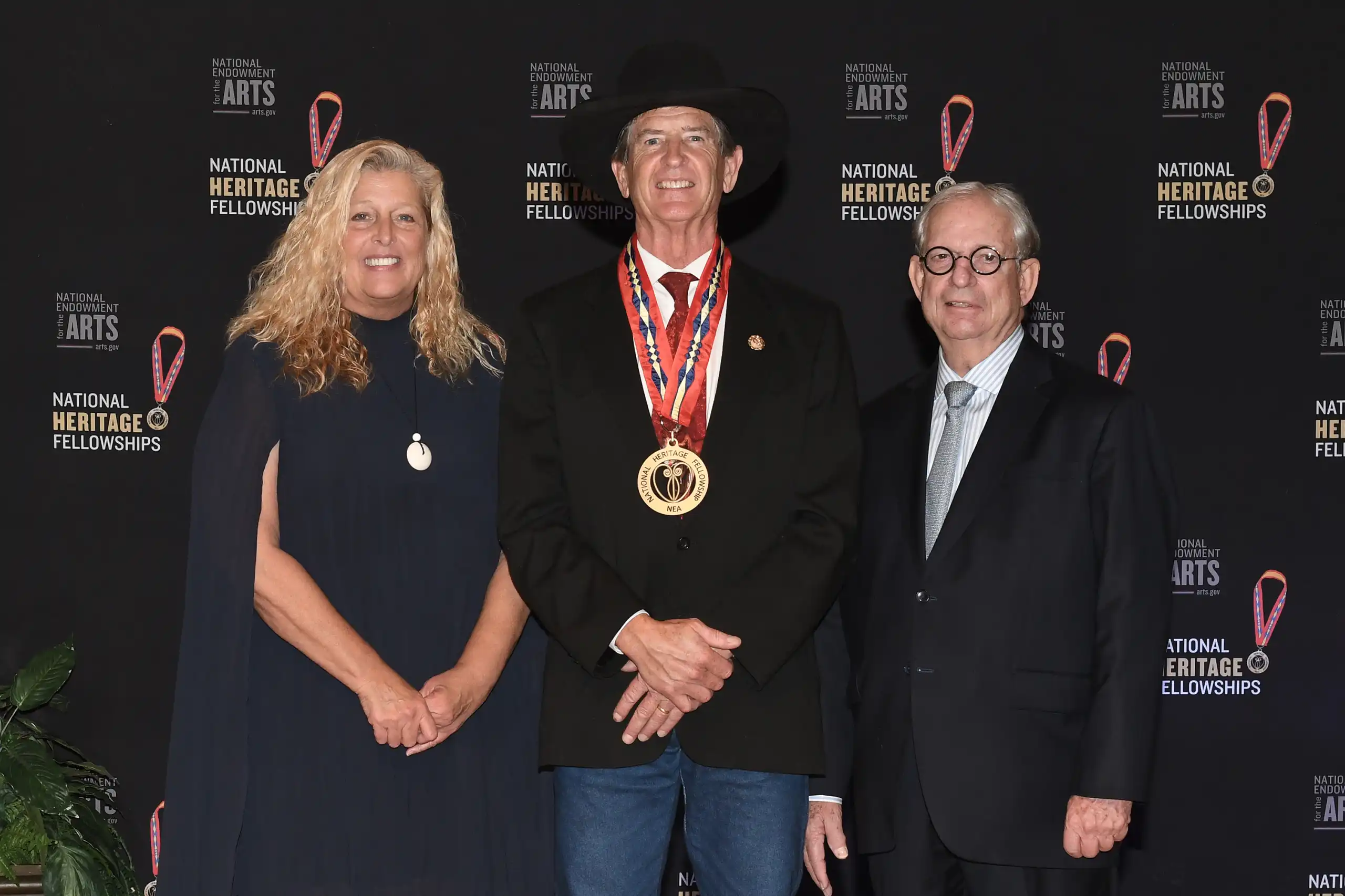
Its fellowship program pairs emerging craftspeople with established TCAA artists for a year, covering the costs associated with that mentorship. Previous fellows have gone on to become TCAA members themselves. That emphasis on passing knowledge forward is particularly relevant to Schwarz, who has made teaching an important part of his own career.
There Is Always More to Learn
Schwarz does not describe his work as finished. After all these years, the interesting part for him is in not knowing everything. It is realizing how much there is left to learn.
“I am trying to improve every aspect of my trade. My mind never seems to be on autopilot. What has happened is that the more I learn and grow, I realize that there are unlimited artistic themes to be explored.”
Even now, there are fundamentals that he continues to work on.
“I am still trying to figure out how to make my hand sewingbetter and have a deeper understanding of how a saddle tree fits on a horse’s back. This is all a lifelong learning process that I’ve become addicted to.”
Teaching, he says, reinforces that process.
“Through teaching my trade, I have an opportunity to learn deeper levels of craftsmanship and artistry. When you are required to articulate concepts so that they make sense to someone else, you find yourself in the pursuit of coherence for yourself as well.”
That philosophy extends beyond his own shop. Schwarz helped launch the Saddlemaker Summit in Idaho, creating another place where makers can exchange skills and ideas. For his bestowed honor of National Heritage Fellow, the NEA notes his work through workshops, apprenticeships, and instructional videos, as well as his weekly podcast, Monday Mornings with Cary and Willie, co-hosted with bit and spur maker Wilson Capron. It is quite clear that Cary Schwarz is a powerful voice in saddlemaking.
Looking Through the Windshield
Schwarz is concerned about what happens when traditional crafts are treated only as historical artifacts. “Handmade craftsmanship and artistry have been a staple within the Cowboy Culture of the American West for a very long time, even with the headwinds that have been encountered. It would be a travesty if this were not maintained at a high level.”
He sees the work as something of a countercultural endeavor in an increasingly mass-produced world. Choosing something made by hand is a choice to value time, skill and human connection over speed and uniformity. It is also a way of keeping traditional craftsmanship relevant and not as a relic of the past, but as a living practice with a place in the modern world.
“We sometimes think of this as a counter-cultural movement. What would be lost is the appreciation for contemporary craftsmanship that would support makers in the cowboy disciplines. Rather than looking out the window and seeing these works being used and cherished, we would be looking at them only in museums and historical preservation events.”
Then he returns to a metaphor of looking ahead.
“The view would be only in the rear-view mirror and not the windshield in the present with an eye toward the future. We would lose an important aspect of an embodied life that makes, uses, and otherwise appreciates the work.”
That idea – that craftsmanship belongs in the present rather than simply in the past – runs through nearly everything Schwarz does. It is there in the TCAA. It is there in his teaching. It is there in the collector saddles that allow him to experiment and in the working saddles that must withstand years of use. And it is there in the way he talks about handmade objects.
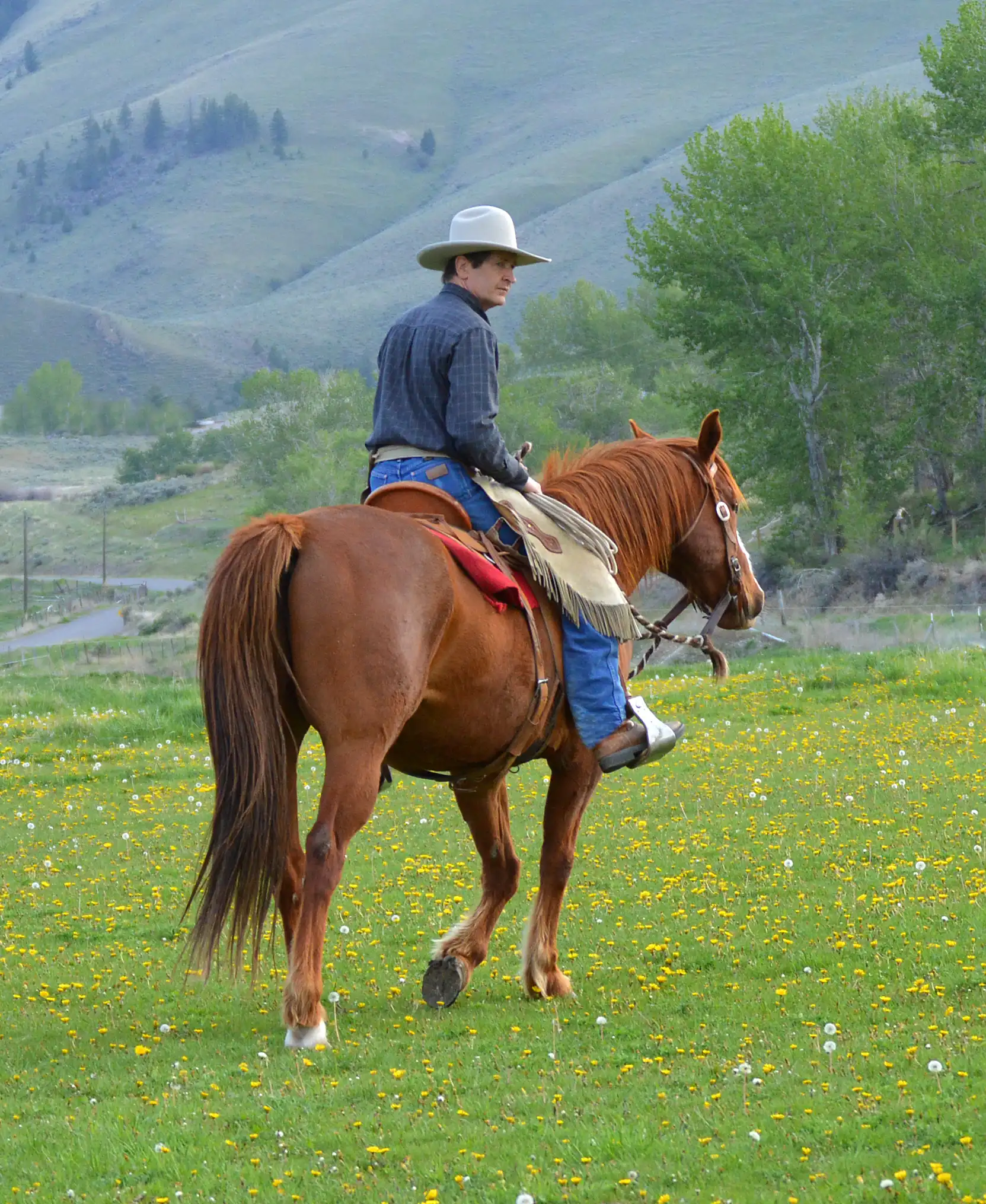
“We are starved for hands-on accomplishment, and we can experience this embodied life by purchasing work that has been made with care by a craftsman. There will always be an appreciation for work that has been produced by human hands.”
The recognition from the NEA arrives at a point in Schwarz’s career when preservation and innovation have become inseparable. The honor recognizes what he has already accomplished, but much of his own attention remains focused on what can still be learned, taught and made.
The recognition is national. The work remains personal.
Asked what he hopes a person might understand if they encounter one of his saddles a hundred years from now, Schwarz does not talk about his place in history.
“First thought is that I won’t be around, so I could not appreciate whatever may be said about my work then!”
Then he talks about what he hopes the work might inspire.
“Hopefully folks will see that I cared deeply about craftsmanship/artistry and inspire them to ‘go and do thou likewise. My calling in life is to serve my customers as best I can, providing enrichment and deeper meaning for them.”
For Schwarz, that is ultimately what the work is about.
“This is the way I believe we ‘love our neighbor as ourselves,’ to borrow a biblical phrase.”
A saddle begins with leather, but it does not end there. It carries the hand of the maker, the needs of the rider, the shape of the horse, the knowledge of previous generations, and the possibility of another generation learning to do the work. And for Schwarz, that is the real measure of whether the tradition survives – not whether people remember what was once made, but whether someone is still making it.